前言
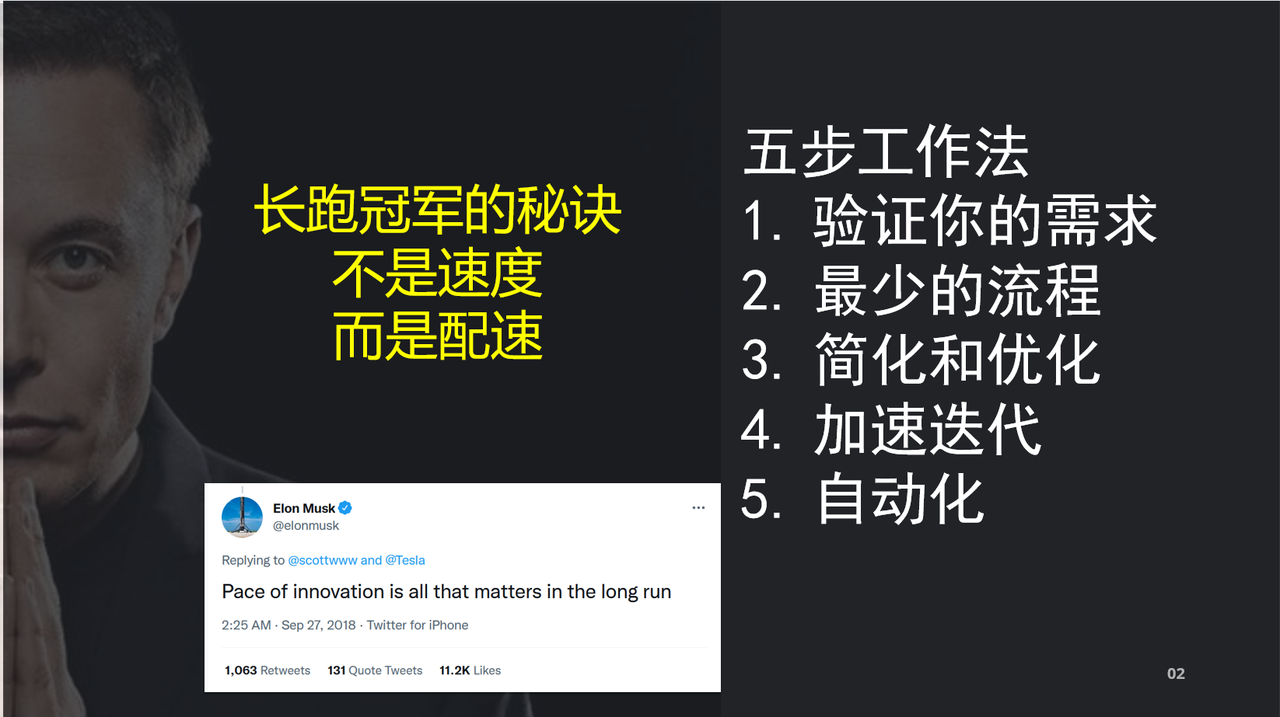
五步工作法在马斯克经历特斯拉Model3汽车的量产地狱(Mass Production Hell)以后痛定思痛,从很多管理失误和错误种总结出来的一套非常有效的企业商业创新管理思路。,指出顺序也不可错乱,因为我本人也经常做IT项目的需求分析,感觉有很大启发,IT行业很多时候的需求并不是做的太少,绝大部分失败的原因在于做的太多,没有关注用户的核心诉求,没有关键的功能点,贪大求全,而导致了失败,这个在很多失败产品上都能看见端倪,相反很多成功产品都是一句话能够说明白的,比如滴滴是打车的,微信是社交聊天的,抖音是make your day,美团是即使零售等等,这里涉及到用户心智,产品定位,当然最重要的是产品设计理念的传达,就是经常说的少即是多(LESS IS MORE)。理解马斯克的成事方法论,理解并加以融会贯通,成为自己工作方法的一个重要的衡量标准,是一个很好的学习方法。
第一步:让需求不再愚蠢 | MAKE THE REQUIREMENTS LESS DUMB
第一步:让需求不再愚蠢。需求肯定存在不合理之处,无论它们是谁提出的,当需求来自聪明人时尤其危险,因为你可能不会充分质疑 —— 因为每个人都会犯错。无论你是谁,都有判断失误的时候。所有设计都存在缺陷,只是程度不同而已。
“Step one: Make the requirements less dumb. The requirements are definitely dumb; it does not matter who gave them to you. It’s particularly dangerous when they come from an intelligent person, as you may not question them enough. Everyone’s wrong. No matter who you are, everyone is wrong some of the time. All designs are wrong, it’s just a matter of how wrong,” explains Musk.
第二步:竭力删减部分内容或流程| TRY AND DELETE PART OF THE PROCESS
第二步:竭力删减部分内容或流程。如果设计中至少 10% 的内容未被重新添加回来,这意味着]删减力度还不够。人们往往倾向于‘以防万一,先加上这个部件或流程步骤’。此外,每项必要的部件和流程必须对应具体负责人,而非部门 —— 因为你无法向部门追问需求存在的原因,但可以向个人询问。
“Step two: try very hard to delete the part or process. If parts are not being added back into the design at least 10% of the time, [it means that] not enough parts are being deleted. The bias tends to be very strongly toward ‘let’s add this part or process step in case we need it’. Additionally, each required part and process must come from a name, not a department, as a department cannot be asked why a requirement exists, but a person can,” says Musk.
第三步:简化并优化设计 | SIMPLIFY OR OPTIMIZE
第三步:简化并优化设计。聪明的工程师最常犯的错误,就是去优化本就不该存在的东西。” 他自己也曾因颠倒这些步骤而栽过跟头。他提到传统学校中存在一种 “思维束缚”—— 无论前提是否合理,你总是不得不回答问题。
“Step three: simplify and optimize the design. This is the most common error of a smart engineer — to optimize something that should simply not exist,” according to Musk. He, himself, has been a victim of implementing these steps out of order. He refers to a “mental straightjacket” that happens in traditional schools where you always have to answer the question regardless of whether the premise makes any sense at all.
第四步:加快循环周期 | ACCELERATE CYCLE TIME
第四步:加快循环周期。你行动太慢了,得再快些!但在着手完成前三项工作之前,先别加速。” 他在此再次举例说明这些步骤为何需按顺序执行:当流程本身存在错误时,你应该直接停下,而非加速。他说道:“如果正在自掘坟墓,就别挖得更快。”
“Step four: accelerate cycle time. You’re moving too slowly, go faster! But don’t go faster until you’ve worked on the other three things first,” explains Musk. Here he uses another example of how these steps should occur in order. During a wrongheaded process you should simply stop, not accelerate. He says, “If you’re digging your grave, don’t dig it faster.”
第五步:实现自动化 | AUTOMATE
最后一步:实现自动化。其中关键在于,当问题诊断清楚后,取消流程中的中间测试环节 —— 如果产品在生产线末端的合格率已很高,就无需再进行过程检验。我自己曾多次在这五个步骤上逆向操作。在特斯拉 Model 3 的生产中,我实际走了‘先自动化、再加速、再简化、最后删减’的弯路。”
“The final step is: automate. An important part of this is to remove in-process testing after the problems have been diagnosed; if a product is reaching the end of a production line with a high acceptance rate, there is no need for in-process testing. I have personally made the mistake of going backwards on all five steps multiple times. In making Tesla’s Model3 I literally automated, accelerated, simplified and then deleted,” says Musk.After Musk describes the fifth step, he goes on to provide some great insight into the Tesla Model 3 battery pack production line and how it evolved. Sometimes when these steps can be completely out of whack, Musk says: “It was like being in a Dilbert cartoon.” Check out the video below for more.